
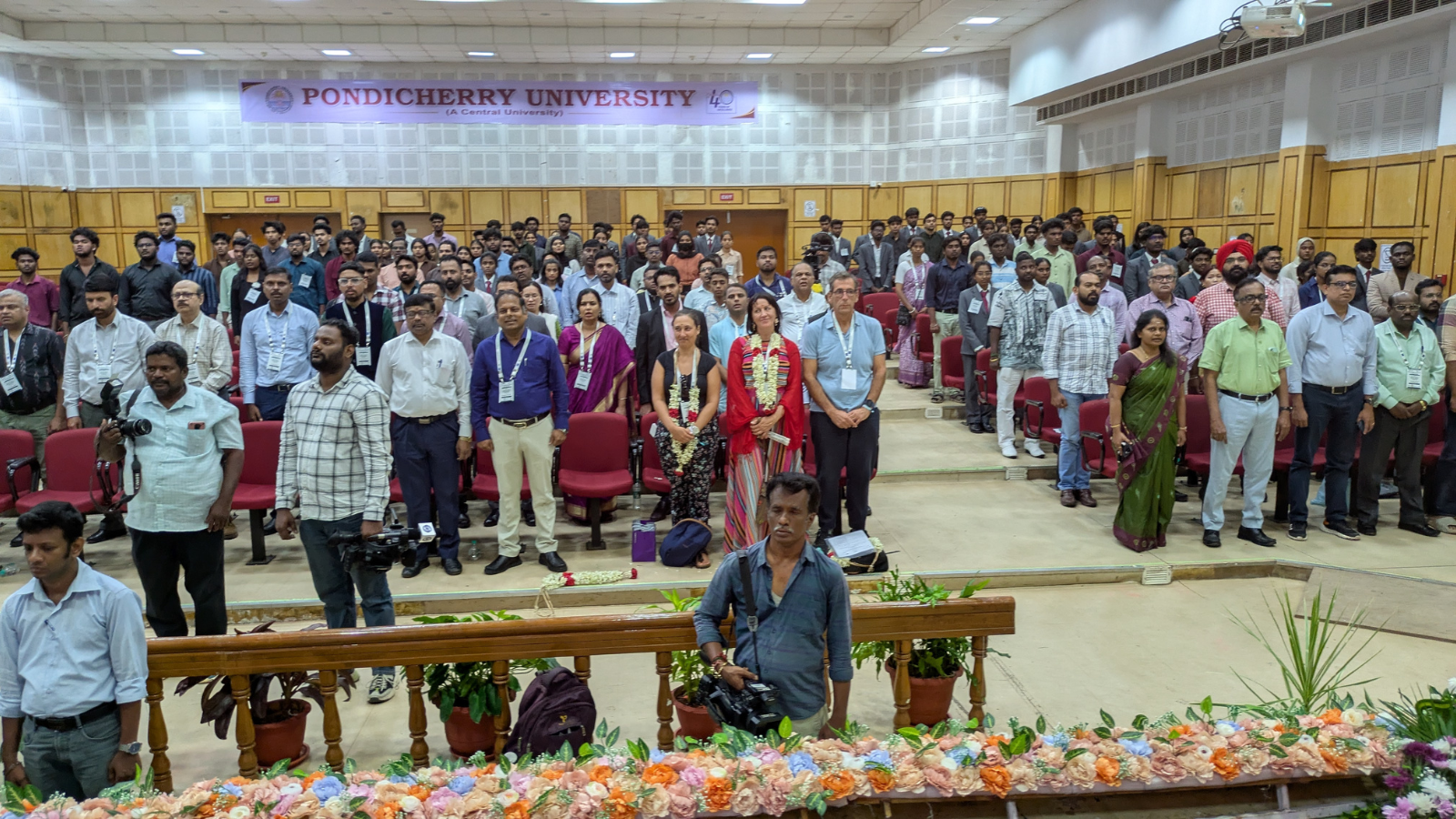
During the first two days of the international conference “Bridging Tourism Academia and Industry: Indian and European Perspectives” at Pondicherry University, particular attention was devoted to presenting the results of the Erasmus+ capacity-building project and exploring ways to strengthen links between tourism education and industry.
The conference forms part of the project “Advancing Sustainability and Technology in Tourism, Hospitality, and Services Studies through Strategic Industry Partnerships” (SIPAS), in which Vidzeme University of Applied Sciences (ViA) cooperates with partners from India and Portugal. The project’s main objective is to enhance the quality of tourism education in India by developing study content on sustainability and stakeholder cooperation, as well as creating new study modules on the application of virtual reality in tourism studies for students without an engineering background and on trends in Asian economies.
The conference brought together representatives of more than 20 higher education institutions from different regions of India, alongside representatives of European universities. More than 100 research paper abstracts were submitted for the conference session dedicated to research presentations. Representatives of Vidzeme University of Applied Sciences, Dr. oec. Agita Līviņa and Dr. sc. admin. Agita Šmitiņa, also shared their experience in discussions and presentations in Puducherry, while Dr. ing. Arnis Cīrulis joined the conference remotely to present the virtual reality (VR) study module developed within the project,
In her opening remarks, Agita Līviņa, a representative of the project’s Steering Committee, emphasised the importance of international cooperation in advancing tourism education. She also moderated a round-table discussion on industry involvement in the study process. Agita Šmitiņa, ViA’s Director of Business Studies and researcher, participated in the discussion and shared ViA’s experience in strengthening cooperation between industry and the university.
“ViA’s experience shows that for cooperation with industry to be meaningful and sustainable in the long term, it should not consist of isolated activities, but should instead be a regular and structured part of the university’s work,” emphasised Agita Šmitiņa.
The discussion highlighted specific examples from ViA, including the Business Laboratory, the Living Lab approach, and cooperation with alumni, which enable students to learn from real-world industry challenges and build closer, ongoing links with the professional environment. Lead researcher Agita Līviņa also demonstrated effective facilitation of a round-table discussion involving ten participants, successfully navigating intercultural differences while ensuring that the discussion concluded within the planned timeframe.
An important part of the conference was dedicated to presenting the results of the SIPAS project and the four study modules developed within it. ViA’s expertise in technology was represented remotely by Associate Professor Arnis Cīrulis, who presented the development and content of the VR module and encouraged Indian colleagues to make use of the materials in their own work.
The following days of the conference will feature research presentations and discussions with project partners on the results achieved, upcoming tasks, and opportunities for further cooperation. The programme also includes sessions with bachelor’s and doctoral students.
The conference programme provides participants with an opportunity not only to exchange professional knowledge and experience, but also to learn more about Indian culture and build informal connections with international cooperation partners.
Information prepared by Agita Šmitiņa and Agita Līviņa from Vidzeme University of Applied Sciences